16 January 2014

3 Reasons We Should've Known How the Golden Globes Were Going to Go Down


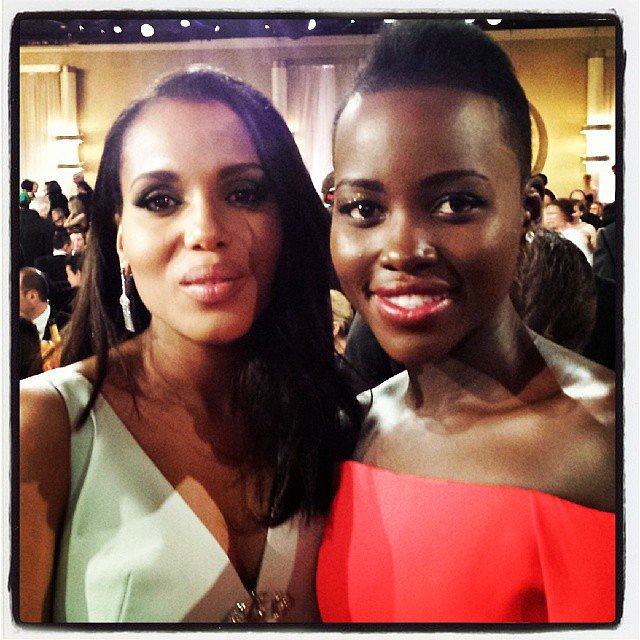
Despite years of evidence to the contrary, people of color went into this year's Golden Globes with excitement and hopeful hearts. This is the year of Black film after all, with movies like 12 Years A Slave receiving critical accolades and even The Best Man Holiday managed to come in second only to Thor 2 in theaters even with its "race themes". So imagine the collective outrage when we watched stellar performances by Lupita Nyong'o and Chiwetel Ejiofor go unrecognized. Or watching in dismay as Steve McQueen was overlooked for his direction and John Ridley for his writing. It was disheartening but luckily folks did not walk away with heavy hearts and the media has been forced to take note of the lack of diversity in both the films and the Hollywood Foreign Press. Still hindsight is 20/20 and there were signs about how this was going to go down:

1.  The best television nominees: Both Andy Samberg and Taylor Schilling were nominated for Golden Globes for their roles on Brooklyn Nine Nine and Orange is the New Black, respectively. This was a big deal as Brooklyn Nine Nine is a relatively new and unknown show and Orange is a Netflix original so it does not have a major network backing it. Furthermore, both shows feature ethnically diverse casts. So that was our first sign. Despite the fact that both shows have received praise for their largely PoC casts, none of those actors were nominated for supporting actor Golden Globes. Arguably, Orange's most memorable characters are Uzo Aduba's Crazy Eyes and Laverne Cox (a trans woman of color) as Sophia Burset. Yet only Schilling was nominated. Even creator Jenji Kohan has been outspoken about wanting Orange is the New Black to be about the Black and Latina women of the prison but knowing that the show would not sell to the industry without a White lead. 

2. Chiwetel & Idris being nominated: I was elated (elated!) to see that both Idris Elba and Chiwetel Ejiofor were both nominated for best actor in the film and television category. Having seen Mandela! and 12 Years A Slave as well as the actors' turns in Luther and Dancing on the Edge, I thought, "Yes! The Hollywood Foreign Press gets it." I figured Chiwetel would win for film and Idris for television because who could deny Idris' morally ambiguous John Luther (the HFPA and Emmys ate it up for years with Hugh Laurie as House) and Chiwetel was a revelation as Solomon Northup. All tied up, easy peasy. But of course they were never going to win. Either their performances would split the vote or they were thrown up there as symbols, either way it was a bone we too easily reached for. 

3. The Hollywood Foreign Press Association: The past year has been marked by some injection of diversity into the Academy of Motion Picture Arts and Sciences so people have been looking to this year's Oscars and the Golden Globes to show those changes in both the selection and the recipients of these awards. But the HFPA is a much smaller pool. It's comprised of about 90 members and although a bit more diverse in its ranks, it's members are still largely from Europe and also male. Unlike American Hustle, there was nothing sexy about 12 Years' sex scene where Michael Fassbender rapes Lupita Nyong'o in a scene that feels never-ending. And there's something truly groundbreaking about Steve McQueen's decision as a director to never turn away from that brutality. 

At the end of the day, no one is saying that Golden Globes or Oscars or any awards should be given to people of color because they are minorities or because of some perverse affirmative action. What we are saying is that it is 2014 and the gatekeepers are still White and male. The oppurtunities go to those who are mainly White and/or male. And as Rowan Pope said this season on Scandal, we still have to work twice as hard to get half of what actors get. I know acting is subjective. I was moved by Michael B. Jordan's portrayal of Oscar Grant and Naomie Harris' Winnie Mandela as well as Adele Exarchopoulos in Blue is the Warmest Color and none of those actors were even nominated but it's more likely that Adele or Jennifer Lawrence will be at the Golden Globes next year (whether they are nominated or not) because they are what we think of when we think of Hollywood, beautiful, White starlets. And despite an audience that is clamoring for diversity and big numbers for television shows and films that are providing that, at the end of the day the industry is still lagging behind. As Alfre Woodard said, 
You know when we'll know things have changed? You know that brilliant, stunningly beautiful and poised Lupita Nyong'o? 12 Years A Slave is an incredible launch to a career. And this is her first thing. We will see if [as opposed to] another brilliant actress Jennifer Lawrence, we'll see the trajectory of [Lupita's] career path and what she's offered after that. Then we'll know whether things have changed or if Lupita is consigned to playing a second banana ensemble person for the next ten years. 
So far Alfre's words seem like an omen. The ball's in your court Hollywood. 

24 December 2013

The Lost Demographic: What My Black Mom is Watching on TV

When I entered the kitchen this morning, my mom was watching a rerun of Family Matters ... I know. Family Matters y'all. While I look on shows like this it's with nostalgia and a bit of wistfulness to my mom this is regular television viewing. 

Now this part is for the TV execs, so listen up. I know my mom isn't part of your hallowed 18–49 demographic but somehow CBS is always number one despite the fact that is mainly watched by the 60+ set so maybe it's time to think outside of the box since my contemporaries are running away from traditional television. And when it comes to older women of color like my mother, you've really dropped the ball. If I grew up in the so-called "Golden era" of Black television when shows like Family Matters, Cosby Show and The Fresh Prince of Bel-Air ruled their airwaves, that was all my mother knew. She knew Good Times and Julia and Sanford and Son and that only got better as the 80s and 90s went on. The late 90s and early 2000s saw a dramatic shift in media representation of people of color and the loss of networks like UPN and the WB which focused largely on Black sitcoms. And my mom and older women of color like her, never went back. Outside of her "stories" or soap operas (which are also being phased out), my mother actively watches reruns of Black television shows. Recently, she's started watching Scandal, though it took me over a year to get her to watch an episode because she initially wrote it off as being another "white people show" despite the fact that it is produced by and stars a Black woman. And I don't blame her initial reaction. 

The truth is over the past 10-15 years, Black people have been relegated to the sidelines of television. We are the sidekicks, the best friends, the diversity hires. No wonder everyone gasps in astonishment when shows like The Game premiere on BET to record breaking numbers or when "race themed" movies like The Best Man Holiday top at the box office. Executives have forgotten how shows like The Cosby Show were once the cornerstone of network television but people like my mom haven't forgotten and they'd rather watch reruns than take in media that doesn't represent them. Recently, things have started to shift slowly back. We are seeing people of color heading up casts and their characters being treated like actual human beings rather than props for the white characters to emote around. But will we ever get back to a place where an all-Black family on television isn't seen as just a show for Black people? Will we get back to a place where my mother sees herself reflected on television and others can see the universal humanity in a Black family? 

11 October 2013

Karma

Today on my way to work, I saw a blonde haired, blue-eyed woman standing legs parted, hands behind her back and bag strewn on the ground as she was being arrested by three police officers. And I walked by, I smiled. 

Now, I completely own that my reaction was sick. No one should get joy from watching as someone is arrested. The way police officers demean and make of spectacle of arresting someone makes a pit rise in my throat. But I also can't act like seeing this moment didn't make me a little happy. And that's a real problem. 

I would say around once a month, I see black young men subjected to the same acts of degradation. Young black and brown men, sitting handcuffed along walls as cops lean over them menacingly. Every day as I walk to work I pass by numerous homeless people, the majority of whom are people of color, and watch as the Twitter techies, businessmen and yes, even I sidestep them on our way to our offices after getting our locally brewed coffees. So when I saw that girl being arrested, I smiled because I was happy that it wasn't one of us. It was one of them for once.

And to be honest, that's not justice. Having just as many White people in our corrupt penal system as there are Blacks or Latinos is not justice. It just means more people are being stripped of their basic human rights. Having just as many White people in our overcrowded, underfunded public schools wouldn't be justice either. I don't wish ills on people in order to make the ills of society seem equal. But I did smile. I had a moment of feeling like some sense of karma was being doled out by the universe and I admit it wasn't right. We can't always help how we feel in a particular moment and no matter how many White, blonde haired, blue-eyed girls are arrested, that won't change the fundamentals of our society. Real change like that might actually bring some real joy to my smile. 

08 July 2013

The Plight of the First Generation Eldest Sibling*

*A/N: That title sounded bleaker than I meant it to but ...

Shout-out to all the firsts. 
The first to go to college, 
the first to get a job, 
the first to move out, 
the first to really succeed. 

The translators,
the navigators, 
the form filler out-ters. 

The ad-hoc financial aid counselors,
the conciliators, 
and conflict mediators. 

The big brothers and big sisters who are expected to come back
Who want to come back
Who can't come back

The ones to whom family is another full-time job
The ones who are raising kids they never birthed
But bathed

We were the first to leave and we're the first to return
We feel the weight of success 
And bear the burden of not having done enough
While trying to do the most

Shout out to the oldest (not the wisest) 
Shout out to the middle kids for whom this is true
And shout out to the only-ies, cause it's lonely

Shout out for the first but not the last

08 November 2012

Sumptuous but Unsubtle

Tonight I had the oppurtunity to see a free screening of Anna Karenina starring Keira Knightley in the title role. It was definitely intriguing and at times spell-binding, but (as is my way) there were certain aspects of the film I just could not get past. Full disclosure: I have never read Tolstoy's novel (though now I am inclined to), so I have no knowledge of the source material. The only thing I knew going into this story was *spoiler* she throws herself on the train tracks in despair over her lover. So with that ahead are the things I loved and the things that made me go hmmmm ...

14 May 2012

Media Reformation

In the article, How Luther Went Viral, The Economist shows us that what we today view as the grand experiment of social media is actually nothing new. In fact, Martin Luther's Reformation couldn't have happened without the social media mechanisms we currently take for granted (take a second to imagine Martin Luther and the Pope engaged in Twitter beef). But while we acknowledge how today's social media is just another link in the chain, we also have to take into account how the increased accessibility of today's social media makes it unique and also dangerous.


09 May 2012

The Need to Justify

What is it that compels us to justify our choices in life? On the internet it can become a blackhole of back and forth but in real life, it seems to all boil down to some intrinsic need to prove our worth; to have other people understand our intent. But at it's core, it's impossible and most of all, it's tiring. After reading, Dodai's incredibly personal article, When Motherhood Never Happens, I scrolled through the comments and I realized that what was driving points on either side of the comments was the need to justify our life choices. 

Those that were for motherhood felt the need to explain why they had kids and let everyone know that "I still have fun!" and "My life hasn't ended!". At the other end of the spectrum were the cries of, "I can travel and drink and I'm happy!" and "At least I'm not overpopulating the planet!" You know who I respect? The people in the middle. The people who don't judge and don't justify. 

I'm going to turn 29 this summer. When I pictured my life, I always thought I'd have a family, a partner, and own my own home (typical, but true). But I never gave myself a time limit. I never set myself in a particular place. I just always thought that when I had acquired the resources to have those things (the right mindset, some accomplishments, financial stability) those things would materialize. I grew up having my mom drill into me that I wasn't supposed to get pregnant at a young age, I was supposed to finish college and get a well-paying job, I wasn't supposed to depend on a man and I followed that plan. Now as I head towards twenty-nine, my mom's story has changed drastically. "So when are you going to settle down?" is a question that comes up in our conversations. And you know what? I don't answer it. I'm not going to justify to anyone why I'm not living my life on their timetable or their terms or based on their morals. 

I recognize that there is a finite time period in order for me to have my own biological children but guess what? I can't force the pieces into place. And I don't want to. So we have to stop forcing everyone to prove their happiness. To justify their worth. Because that is what divides us. The minute you justify your childlessness by downing motherhood, you've lost the argument. And when you equate your worth to your choice to pop out a kid, you've put someone else on the defense (or honestly in the case of women who can't conceive potentially called someone else worthless because of something they can't help). So stop, just stop. Do you, be you, and justify it to no one.